26 October 2010

Maroon 5, Hands All Over (2010): Album Review

Maroon 5. We’ve all crooned to their hits “She Will Be Loved” and “Won’t Go Home Without You” on the radio with the windows down and stereo up. Originally known as Kara’s Flowers, this group of Los Angeles high schoolers struggled to find success throughout the mid-1990’s. It wasn’t until 2002 when they changed their name to Maroon 5 and released their debut album, Songs About Jane, that the band exploded—dominating the Billboard charts and winning the Grammy for “Best New Artist.” Their sophomore album, It Won’t Be Soon Before Long, brought the group even more acclaim—shattering iTunes sales records, and transforming them into international superstars. Now, we anxiously wait to see where the new album entitled Hands All Over will take the group. Recorded in Switzerland in 2009 with the help of Robert Lange—producer for such bands as AC/DC and Nickelback—frontman Adam Levine has described the album as a “hybrid” of their last two; highlighting the best elements of each, while branching out into some rock and even country territory.

The album begins with “Misery”—the funky single released earlier this summer, bringing to mind the feel-good thumping of their early hit “This Love,” with a bit more of a disco-esque flair. “Stutter” brings a taste of twangy rock to the album, while still maintaining that breezy, light-hearted feel that Maroon 5 is so well loved for. Another tune, “Don’t Know Nothing,” almost has a 50’s jukebox feel to it; although a solid effort, I could only imagine how it’d sound if the likes of Amy Winehouse got a chance to tackle it. “Never Gonna Leave This Bed” is the quintessential morning-after ballad with sweet and simple lyrics, which are highlighted even moreso in the acoustic version featured on the Deluxe Edition of the disk. The title track, “Hands All Over,” features a bit of an angry rock edge very similar to that of “Wake Up Call” on their previous album. The best track on a whole, in my opinion, is definitely “How.” The group lays off the heavy guitar riffs and drums to showcase the piano some more, bringing Levine’s impressive falsetto and the catchy earnestness of the chorus to the forefront. And I guess entitling your song “Runaway” automatically makes it good—first Kanye with his new tune at the VMA’s, and now Maroon 5 with their upbeat song of the same name which showcases some gospel influences. The band slows it down with some easy bongo drum beats for their surprisingly good country collaboration with hot new artist, Lady Antebellum—perfectly meshing together Levine and Hilary Scott’s stellar vocals. The bonus tracks included on the Deluxe Edition are also all very worth the extra 5 dollars paid for the album. “Last Chance” plays like a dark tango ballad, while “No Curtain Call” is yet some more gloomy fare about the crumbling of a relationship with a lively, catchy chorus. The acoustic version of “Misery” is also definitely worth a listen and helps wrap up the album on a mellow, soulful note. Like any album, Hands All Over is not without its weak links. Their second single“Give A Little More” seems more suited for the 70’s discothèques of the ABBA generation, and “Get Back In My Life” just has a very strange vibe with no definite chorus or song structure in general.

So, do I think this is an album worth buying? Absolutely, and I’ve already listened to it nearly all the way through 4 times since I’ve purchased it. There are no real “standout” songs, which serves good for the album on a whole, but doesn’t bode so well for its future on the radio waves. Levine has also stated his plan to make 1 more album with the band before dismembering. Already 3 for 3 in my book, let’s hope for a solid finish to the irresistible and catchy era of Maroon 5.

21 February 2010

WTF?


OK Go is one of those bands I find myself listening to, but never truly feeling any emotion or connection with their music. True, “Get Over It” forms part of my guilty pleasures playlist for strange reasons I can’t even express, but nevertheless, OK Go is a band that always makes me wonder what their musical identity is.

Of the Blue Colour of the Sky is the band’s third studio album produced by Dave Fridmann, the man behind great albums like MGMT’s Oracular Spectacular, The Flaming Lips’s The Soft Bulletin and Yoshimi Battles the Pink Robots. The album is a conceptual interpretation of General A.J Pleasonton’s The Influence of the Blue Ray of the Sunlight and of the Blue Colour of the Ski, a compilation of numerous passages written by different authors that gives facts and research on topics varying from physics and general health. Of the Blue Colour of the Sky is the bands greatest work to date, by a landslide. The album has a connecting thread that guides its listeners from song to song without leaving anyone dazed or confused like much of their earlier work. The album is musically interesting; it delves into this new electronic age we’ve been in for awhile now, but it begins and ends there. Of the Blue Colour of the Sky doesn’t feel original, but nowadays originality in the mainstream world is not as important as it used be.

The lead single, “WTF?” is full of static and layers that hide Damian Kulash’s vocals making it fun for awhile, but ultimately it just is; no rhyme, no reason. The album continues onto “This Too Shall Pass,” which I see as a perfect song for a car commercial or one of those drink commercials where people finally liberate themselves from their boring offices jobs into the streets, dancing. “All Is Not Lost” is just a continuation of the last song while “Skyscrapers” does a complete one-eighty into a cool jazz tangent, which coincidentally does not feature much of Kulash’s voice. The song transitions into “White Knuckles,” a continuation of a happier sounding “Skyscrapers.” Again, we are thrown into the OK Go “Blender of the Unknown” where out comes a futuristic, auto-tuned song “Before the Earth Was Round,” a song about the sadness of loosing humanity. “Last Leaf” was a nice departure from all the computerized instrumentation into Kulash’s raspy vocals and guitar. The album is closed with “In the Glass,” the album’s best song. The song has a very dark tone that is enhanced by the electric piano. Also, the lyrics were compelling because each of us look in the mirror everyday to asses “what have we done?”

It was difficult to judge the album by itself without populating my thoughts with their earlier work, but as a band that has recorded three albums I found it necessary. The album is not an impressive piece, but it entertains the ears for awhile.

16 January 2010

Between the Buried and Me/Cynic/Devin Townsend Project/Scale the Summit @ The Clubhouse 1/15/2009


Scale the Summit opened the show but despite the fact that I showed up before doors, I was unprepared for the monstrosity of a line that filled the entire mini-mall where the venue is located. As such, I made it in for approximately the last minute of the set. But it sounded good, I wish I'd been able to get inside faster.

Devin Townsend is one of the men in metal who I just seem not to get. His stage presence is decidedly crazy and evil feeling (not in a bad way) and his vocals are absolutely fantastic, of the level where they're worth listening to no matter how the rest of the music sounds. Unfortunately, I just tend not to dig any of the music he writes or performs. Like Mike Patton, he's great to listen to just for the sheer talent, and live he's a real treat to watch; he puts a ton of character into his performance. But unlike Mike, I find I don't ever sit down and think "I want to listen to a Devin Townsend album." That being said, I would love to see him live again some time.

Cynic was the band I was most excited to see, without question. Though they've been touring since the release of Traced in Air on and off, in general it's not too far askew to suggest this is the first opportunity I've had to see this band in about 15 years. Couple that fact with the fact that I rank Traced in Air as the best metal release of 2008, and you have a general idea how excited I was to see this band. The technicality comes out well live and the execution is solid (essential for a band like Cynic), and though I was disappointed they did not play Traced in Air straight through, as it seemed they might do when opening the set with the first couple tracks, as a whole I found the set list to be excellent. The spoken word/poetry openings to several tracks were interesting, but didn't really add anything as a live introduction; it would have been nice to see other attempts to change up the songs live than just those introductions.

Between the Buried and Me is a band which I love to listen to on CD, and in particular I will sit down and listen to Colors straight through on a semi-regular basis still (it was my pick for 2007's metal album of the year). The associated musical journey has never let me down, and as such I never understood the criticisms I read from time to time about the unnecessary length of many of their tracks until I saw them live. As much as I love the same tracks on CD, live I found some a bit tedious and lengthy. As a fan of live Jazz and Progressive music, I cannot explain the disconnect there, but I certainly found it to exist for this band. The set list was a nice mix of old and new songs (though perhaps short on old songs for those fans who hated the shift in sound found on Colors). I was a little bit thrown by a few song choices, but with a band that writes albums with odd track transitions, I suppose choosing tracks to play live is a non-trivial task and they seemed to manage it alright. Like most progressive bands, the focus was on the music more than the live show, but it was well executed and I didn't find anyone complaining about it in the audience.

20 November 2009

Album Review: Jupiter One - Sunshower

Indie rock is a curious thing when so many of its perpetrators practice a genre that doesn't sound like actual rock--a movement that all too often thinks that awesome, horns-throwing music should be restrained, perhaps made more subtle, because to do otherwise would destroy any image of being cool, which might as well be all that matters to the band. Let's be frank, we've seen a scores of "serious" indie rockers ever since the recording studio was democratized: young musicians in skinny jeans trying to look nonchalant while pretending to go wild. That kind of half-hearted disinterest only succeeds when the music itself is credible.

Jupiter One is not ready to (or simply not good at) pulling off this delicate balancing act with Sunshower, released in the third quarter of 2009. The band's photo in the liner notes gives off that "Oh yeah, we're all just chilling with our instruments; you wanna take a photo? Nah, we don't mind..." vibe, as does, unfortunately, their music. The record starts out well enough, striking up cosmic riffs and revving up the intro with the falsetto "ahhhs" that made the Flaming Lips famous. Turning down the spacey knob a notch, the band does its best VHS Or Beta impression for the verse before switching into the symphony-sprinkled chorus lite, full-flavored without overexerting itself. The average listener would expect roughly the same kind of rock for the other 10 songs. Oh, how you are led to believe this notion! After this flashy starter, the band throws you into "Lights Go Out," a credible body mover that dances through its rhythms, alternating between post-punk's fastest riffs and the most bombastic chords Interpol could think of. K Ishibashi meanwhile croons like he's auditioning for a spot in Bloc Party, and all feels right. So, hey, that style is nailed down. Why not switch up things next song?

And so, "Flaming Arrow" presents an almost whimsical folk rock ballad about arson, and this is where the album missteps for the first time. Everything from this point loses the luster exerted so amiably . "Made in a Day" is "Lights Go Out" lite, adding organ hums and violin whines to what should be indie rock with dance pop sensibilities; instead, we get something cutesy and not so much sung as pled. Deciding to confuse us, next we get "Anna," which jumps in with power pop chords that Boston once rejected. As the first verse bridges into the chorus, the band brings in an industrial-sized vat of kitsch and slathers on the early 80s glam rock, complete with organ swirl and Beach Boys-style cries backing up the punchy rhythm.

And then the band just gives up. We're treated to dance duds nothing like the first half, like "Simple Stones," which is too laid back to sound interested and sounds like elevator muzak for 20-something kids from New York. "High Plains Drifter Finds the Oracle at Delphi" plods along at a maddening pace but tries to make up for it by just slathering on cheese on the melody, alternately tickling the listener with sitar, strings, glockenspiel, woodwinds, and a smooth pop, licked by some strange abomination that sounds like Barry White without soul. The rest of the album wouldn't be worth mentioning if not for "Come On," which carries a faux new wave sound in the name of The Killers without giving up its soft harmonic riffs and roaring chorus blasts, supplemented with "you can't be seriously that dramatic" strings.

The resulting collection of songs sounds about as fractured as a cyclist trying to pedal frantically at 50 miles an hour through a sea of bricks. Sure, you get some solid indie rock that takes cues from respectable new wave and nearly-dance pop; at the same time you get some schmaltzy power pop that Julian Casablancas thankfully chose not to throw into his classic rock-tinged solo album released not too long ago--and I haven't yet mentioned the bizarre folk rock ditties. Why are they there? Why? Why?

There's no good answer. It all sounds like a bad impression of an indie rock band too much in love with itself and whatever it can do. Yes, Jupiter One apparently feels justified in joining together whatever music it comes up with, even if the song choices match up like they were all thrown together at random. The band's got some knack for pop--the first few songs bear that out--but when not in top shape the music is lazy. Seriously, the last half of the record sounds like breakfast for hipsters--its too full of itself to care about the music.

Why? It's just that good.

No. It isn't.

18 November 2009

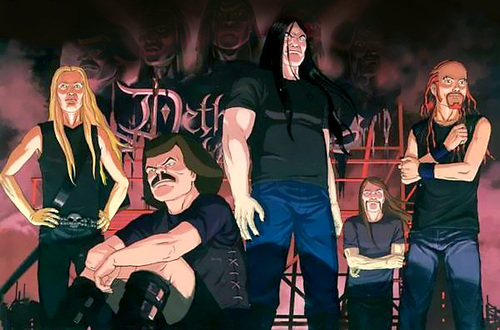
Dethklok/Mastodon/Converge/High on Fire @ The Marquee 11/17/2009


High on Fire is one of the better bands around currently in my opinion, and thankfully that opinion has led to me seeing them headline or play more prominent positions on a few tours, since there was no possible way for me to arrive at 5:30 for their set (a time made even more ridiculous given that the entire show was aver by about 10). I will assume they rocked as usual though and plan to catch them on their next trip through.

Converge played a fairly lengthy set considering their lower slot on the tour, but I was glad to see it. As one of the only metalcore bands who releases CDs I consistently enjoy, it was interesting to see them live. In some ways the music seemed even more aggressive live, but I believe that in part that was due to the muddling of the instruments live which made it even more of a wall of sound (also the kick drum was ridiculously powerful). It was disappointing but not surprising to see so little of the sold-out or nearly so venue really getting into the music. It feels a little cheap seeing these guys on such a commercial tour.

Mastodon played a similar set to what they did when they last came through on a headlining tour, with the entirety of Crack the Skye followed by a couple of old songs. Given that they were not headlining though, the second set of songs was smaller and, frankly, the ones chosen were a bit of a disappointment. The background videos have been improved since last time and are much more coherent and involved in the songs. It's a shame they didn't have as good a video background on the last tour so that both elements of good could have occurred in the same set.

Dethklok was absolutely entertaining start to finish. Though I expected only a screen with music being performed off stage, I was surprised to see the screen going the entire time, but with the full band also on stage, though not interacting with the crowd at all (though Brendan Smalls got into characters for that which was fun). The videos were great, though possibly less entertaining for those who watch the show (I do not, so I have no idea if it was all excerpts or if it was original material). The inter-song videos were also quite fun and helped maintain continuity in the show while the musicians got their rest...much more effectively than most bands are able to pull it off in fact. This felt like a complete show start to finish. Quite cool, I'd see these guys live again even though I don't love the music as much as many other bands just for the show.

06 November 2009

Album Review: Noah and the Whale - The First Days of Spring

This album is not so much a pistol as a shotgun, its ideas roughly discernible as a concept album. Here we have Noah and the Whale, trading bright, poppy folk for gloom. Here the listener is treated to not one but nearly a dozen songs of longing and distress. Not as much cerebral as melodramatic, it's difficult to admit that this record has any staying power.

This is a breakup album--every song on the album makes clear you know that. And while repetition gets the point across, redundant repetition drowns out of the point, and we are left to focus only on the minutiae, where every song is the same by its unity of theme. While we the audience are told from the beginning that spring is starting, no chronological progression is made, even as we are told that this is a concept album, that the narrator is progressing.

Progression is slow, reversible, sidestepped, even redefined. Virtually the same palette of sounds plays throughout the record. I do not slight The First Days of Spring for reusing instruments (as that is never a crime for a band, except in electronica), but the intended impression upon the reader's mind is only slightly changed from tune to tune. I can break down the mood into archetypes: slow, deep, drums, with a slow riff played in the alto range of an electric guitar; light airs played on a piano like wind chimes--the beauty of life; janglyacoustic guitar--raw heart; a violin with a legato like an elephant is tall--the undying romanticism of the hopeless narrator; that ol ' "get all the indie kids together" ensemble, completely with jangly acoustic guitar (the band probably owes Architecture in Helsinki royalties). Now, some diversity stands, but the presence is unmistakably novel.

For the most part, the above mentioned ensemble of ideas is repeated and mixed. Any attempts to sketch the plot will result in just that: a sketch. There's really only a few points of note: spring starts and the narrator has no girlfriend ("The First Days of Spring"). Regret, denial. A weird perpendicular shoot into happy denial ("Love of an Orchestra")? Back down to Earth ("Instrumental II"). Sleeps with a stranger to prove he's not attached anymore ("Stranger"). Even stronger denial that he's still in love with her--claiming he is no longer concerned with his ex-girlfriend ("Slow Glass"), even though she's mentioned for every single song until the album ends. The narrator claims that he failed her and she failed him ("My Door Is Always Open"). End.

Huh? Even as the motifs play out and this slow-moving eleven-song ballad depart, I can only say that the album fails its parts. Too many ideas play out. The orchestral bump in Love of an Orchestra never attempts to unite its differences with the more baroque outlook of the rest of the album. In the end, this is no more a tale of recovering from loss than the ennui of modern infatuation, captured in amber for the world to hear for as long as MP3s will be spread around--for Noah and the Whale and possibly the indie movement, love is not just an emotion or state of mind but a separation from society. Being cut off becomes isolation from not just love but society itself. The problem is that this view is only melodrama. Unfortunately, that is the only view The First Days of Spring is capable of expressing.

26 October 2009

CMJ Update #2 (Wrapup)


I only went to one panel on Friday, and it was about music and film, and may have been one of the better panels I saw. The panelists role-played and went through the choice of a song for a movie or commercial which was really fascinating and educational.

The Slayer listening party was a fun time, complete with Slayer DVD imagery and some Gallows DVD added in as well. Both DVDs are really good in fact, I might have to get them. Really bizarre but fun to see...if you like the weird and possibly grotesque. After the listening party we grabbed some authentic Chinese food in Chinatown and hopped over to the Relapse showcase.

Gloominous Doom opened up the showcase, and though it wasn't what I expected from a band with doom in the name, the music was pretty neat. The band has a bunch of technically solid players who transitioned from ska to dance to metal all in the same song, but the transitions themselves were not entirely smooth, mostly due to teh "purity" of each style played. Putting ska next to grindcore or even jazz fusion is just not entirely smooth no matter who plays it. I'd love to see this band move more progressive a la Between the Buried and Me, and less Iwrestledabearonce.

Howl was a bit more complete feeling than Gloominous Doom, though less to my liking stylistically. I was particularly not a fan of the vocals, though in general something with this band kept them from being overly enjoyable for me.

Complete Failure was a thrashy-y/grind-y band which didn't appeal to me at all. I struggle to see the appeal in music that is all blast beats and speed such that it basically devolves into noise. But that's just me.

Black Anvil were really solid. The first band of the night that the whole audience was really starting to get into, and one of two bands a lot of my CMJ friends were excited to see live. A sort of black metal-influenced hybrid, they keep the vocals black with more traditional metal guitar lines and less tremelo picking which makes for a fun and somewhat unique sound.

Revocation was, interestingly, my favorite act of the night. Normally a death/thrash sort of hybrid would hold no appeal for me, but the music was somehow catchy and good-sounding, and really got the whole crowd energized and moving.

Salome probably could have won top band of the night for me had they been a bit less experimental. Now, I'm all for bands experimenting, even live, but when you're a really doom-y, slow tempo band, experimentation for 10 minutes per song tends to drag and become tedious, very unfortunately. I also didn't dig the vocals. High-pitched screams just don't work in doom in my opinion, it detracts from the heaviness.

After the show, lots of sleep. Saturday was the day off. Did some tourist-y wandering around Times Square with some of my promoters and Kim Kelly, then hit up Jekyll and Hyde for dinner round 1, followed by dinner in Little Italy with Sarah and Becky for dinner round 2. After packing and pulling an all nighter, I hopped onto the plane bright and early at 6 am and came back to sunny Tempe exhausted and a little bit sick. A valid sacrifice for living life like a rockstar, and learning too of course.

23 October 2009

CMJ Update #1

It has been an interesting CMJ event thus far. Unlike previous years, the schedule was packed early and gradually trickles off from there.

Tuesday was a ridiculously long travel day. Leaving Phoenix around 6 AM, I arrived in NYC around 4 PM, and got to my hostel around 5 PM. After checking into CMJ and picking up my badge, I met up with Sarah for some tasty dinner before running to the Dethcote party I'd been invited to during dinner. The music was loud and not good (some dance-y club music), but the beer was free (if you knew the right people) and catching up with all the guys from last year was fun.

Wednesday I went to 4 panels which was pretty intense to say the least. When I showed up to the first panel, about social networking and music, it was fairly empty, but by the end it was packed with people sitting on the floor, and I felt a bit uncomfortable being surrounded by so many hipsters. Moving onto the second panel, I was a bit less overwhelmed by hipsters, since it was about music and mobile devices. Pretty cool stuff thrown around for a tech guy like me. Then there were the two metal panels. The first was great as some of the feedback thrown around might result in some positive changes in the industry, always nice for those of us working in it. The second panel was, well, tense. One woman in the back of the room liked to call all music pirates thieves and had many a rant about how kids were destroying metal. Needless to say, in a room of college kids, that didn't go too well. Of course, most of us get all our music for free legally anyways, because they give it to us. So it also seemed a bit pointless to bring up. Still, the discussion was great.

After the panels I went on the walking punk rock on the Bowery tour/bar crawl. That was a great tour where we went with our tour guides to several historic areas of New York and discussed how punk rock started in new york in the mid-1800's, with the gangs of New York. Interesting ideas, and lots of great history. Also saw where CBGB's used to be and saw one of the only real dive bars left on the east side. After the tour we went on the annual bar crawl and there was a lot of great socializing going on whilst drinking copious amounts of alcohol.

Thursday was college day and somehow I managed to get there on time despite the drinking of the night before, and enjoyed a nice, free breakfast. After breakfast, a couple of panels went on, and Sarah met up with me between the two and we got a lot of great ideas about things to do to improve the station, which is always exciting. A couple of bands played during the lovely free lunch, and the second one was particularly interesting, though I didn't care for the vocals. After another panel was the college radio awards, and though I didn't announce an award this year, it was completely entertaining and fun. After the awards I ran off to the open bar before a showcase, drank as much in two hours as I had during the entire bar crawl, and a group of us stumbled up to another bar after the showcase to watch the baseball game. After a few more beers we went up to the Comedy Central showcase and enjoyed some comedy before heading home for some rest.

Tonight is the listening party and Relapse showcase, should be good times. There will be a second update soon.

11 October 2009

Album Review: The Flaming Lips - Embryonic


I'm surprised Warner Bros. let this album see the light of day--who listened to this and decided that, despite its complete and utter disregard for Top 40 polish, Auto-Tune shine, and concise songwriting, this was music that would make the record label lots of money? Wayne Coyne and co. have never cared much for convention, sure, but Embryonic takes the band completely out of their familiar environment and gives us an idea of what Can might have sounded like if they found out they liked the sound of Vivian Girls.

On one hand, we have the sound of The Flaming Lips that is familiar to anyone who's heard any of their work after 1997. Punchy drumloops propel all manner of synthesizers and guitars through striking, beautifully rendered chords, as well as Wayne Coyne's own strangely in-tune voice. And with their carefully perfected bag of tools, the band shows off their artistic mastery of their instruments, sailing through tender slowness akin to The Soft Bulletin and rocking out like they'd only started touring yesterday in support of Clouds Taste Metallic.

And yet, there's this new side of The Flaming Lips that we haven't seen before--their experimental side. Avant garde? Maybe. It's arguable that Embryonic is that motivated to be so abstract when so much of the album focuses on melodic and rhythmic elements, as opposed to pure noise or arrhythmic pieces. Time signatures? Check. Key signature? Check. Melody? Check. The real avant garde masters would be offended. Lightning Bolt wouldn't let Embryonic into the same room as their material. Even listeners new to any Flaming Lips work at all would be able to tell that there are recurring elements that might constitute their repertoire--the drum loops, the voice (of Wayne Coyne), the slow, throbbing brainwave-stimulating synth loops, the dreamy atmosphere. If you were hoping that the band would venture into Throbbing Gristle sounds, you would be wrong. This is definitely tonal.

The result is the musical equivalent of half and half: half old material, half new modes of expressing that old material. Part of me feels like I'm simply hearing the sappy parts of The Soft Bulletin fed through a guitar amplifier. Is that a bad thing? If you don't mind lo-fi, you won't mind the new modus operandi. If you demand that classic Flaming Lips audial polish, this record will both appeal to you and annoy you to death. You will hear echoes of previous album At War with the Mystics (think "The Sound of Failure/It's Dark... Is It Always this Dark??") and some more. Get ready for pinging delays with deep reverb ("Powerless"), what may be called way too much vocoder saturation ("The Impulse"), freakouts! ("Silver Trembling Hands," "Virgo Self-Esteem Broadcast," "Scorpio Sword"), some random dude doing some poetry recital or something like that ("Sagittarius Silver Announcement"), glitch-style rhythmic noise ("Convinced of the Hex," "Worm Mountain"), and just about every freaky trick in Wayne Coyne's playbook.

In a way, Embryonic is the natural evolution of The Flaming Lips. Their earliest albums were noisy, wretched, and wild. Then the band matured and smoothed out the edges. Then they found nostalgia for their youth and merged their two worlds. We are at that last point. And as I listen to the songs again and again, I realize how much this style suits the band--so weird, but so beautiful. It's like The Album Leaf got drunk with TV on the Radio. Even as Wayne Coyne croons high and slow in "If" and a lazy bass strums along and all manner of amplification and synthesizer crash together for static jam "Worm Mountain," the twin paths are never more apparent. If you're left wondering why the hell The Flaming Lips would bother to do something so different, the answer is that it's really the same thing they've always done. Perhaps we're in familiar territory after all. But with The Flaming Lips, who can tell?

08 October 2009

Album Review: Dappled Cities - Zounds

It's been a while since Dappled Cities Fly dropped the last word of their group name to become Dappled Cities--I guess the band just wasn't fly enough. (Cue intro music to CSI: Miami.) It's been longer still since I first heard the few ringing strums of their debut, A Smile, fitted with all the meat of indie rock and the jangly sound of twee. But make no mistake--their newest effort, Zounds, is a beast of a different mythology.

Dappled Cities offers a full, rich album, lined with pastiche and filled out with big, bombastic detail. The band makes no apologies about jumping into that muddy area between electropop and indie rock that so many bands have explored--terrain charted by Of Montreal, Cut Copy, and innumerable artists. Zounds makes a conscious effort to fill every second of every song with sound; where there is no instrument playing, there is an echo of one. "It does not matter if something belonged there in the first place--there must be a something," this album says to me.

Zounds
is as artistic as it is a serious indie album, defying ownership both by pretentious hipsters and pop aficionados. The word itself is both an interjection and a summation of the wild sounds the band produces. One only has to look at the cover of Zounds to realize how scatterbrained the music is. The photograph that comprises most of the cover's real estate portrays a band in a room, sprinkled with confetti, filled with the strangest of objects-- a ladder, the trunk of a tree, a large balloon in the shape of a 3, a piñata, several photographs, and several sets of hands playing a keyboard on the floor.

It all serves to give context to the music ensconced within the disc--this is art. True enough, the mix of buzzing, whirring, gurgling, and thumping that starts the recording with "Hold Your Back" establishes the new and improved Dappled Cities as an Of-Montreal-cum-Animal-Collective-cum-Shins amalgamation that just wants to blow your mind, not with wacky exuberance or springy lyrics but with a complete tonal invention, combing through the lessons alternative music learned in the last 20 years and making notes about each of them. Each song is a synthesizer-driven indie rock song, dressed in the trimmings of that wholesome indie style--multi-instrumental, full, busy but not fabricated. I feel like Animal Collective grew became pensive, decided to slow down, and determined to find joy in life.

The listener at every turn is led, never quite able to determine the course of each tune. The album revels in the cerebral, each tune not quite the same and made of different inspirations. The listener is mislead through each song not by the style of the music but as a matter of course--who would expect the infectious danceable "Miniature Alas" to be preceded by a bizarre spoken word ditty? Zounds is an album that completes every idea--whether it's the moody "Wooden Ships" bursting into a baritone chorus suddenly or the punchy delivery of the chorus on "The Price," nearly every creative choice by the band feels natural and purposeful--"It should have always been like this," I feel. Even if many sections of the song feel like A, B, and back again, there's always a subtle (or major) tweak produced to bring the old idea to new life.

It's easy to tell that the band is having too much fun with the album. Their grandiose patchwork of multi-instrumental chaos and graceful--sometimes over-ambitious or ambiguous--lyrics will strand careless or uncaring listeners in a sea of confusion. The density of Zounds lends it weight that will wear out an audience expecting easy listening. While by no means does the music turn into noise, there is little doubt that songs like "Apart" must be experienced, not simply heard, to be understood. The steady march of lurching indie rock (Wolf Parade style) accompanying the nearly falsetto vocals can leave the unaware audience in a haze of ill feeling. The defiant "Stepshadows" plays like a funeral dirge for a chase scene in a 1990s Western, self-satisfied by its own certainty.

Thought and creativity went into this collection of songs, but it might be more difficult for the listener to ascertain what exactly the band was thinking. You are guaranteed a sonic canvas that only years of artistic endeavors will paint. After all, Daft Punk didn't write Discovery in a day.