Showing posts with label indie. Show all posts

20 November 2009

Album Review: Jupiter One - Sunshower

Indie rock is a curious thing when so many of its perpetrators practice a genre that doesn't sound like actual rock--a movement that all too often thinks that awesome, horns-throwing music should be restrained, perhaps made more subtle, because to do otherwise would destroy any image of being cool, which might as well be all that matters to the band. Let's be frank, we've seen a scores of "serious" indie rockers ever since the recording studio was democratized: young musicians in skinny jeans trying to look nonchalant while pretending to go wild. That kind of half-hearted disinterest only succeeds when the music itself is credible.

Jupiter One is not ready to (or simply not good at) pulling off this delicate balancing act with Sunshower, released in the third quarter of 2009. The band's photo in the liner notes gives off that "Oh yeah, we're all just chilling with our instruments; you wanna take a photo? Nah, we don't mind..." vibe, as does, unfortunately, their music. The record starts out well enough, striking up cosmic riffs and revving up the intro with the falsetto "ahhhs" that made the Flaming Lips famous. Turning down the spacey knob a notch, the band does its best VHS Or Beta impression for the verse before switching into the symphony-sprinkled chorus lite, full-flavored without overexerting itself. The average listener would expect roughly the same kind of rock for the other 10 songs. Oh, how you are led to believe this notion! After this flashy starter, the band throws you into "Lights Go Out," a credible body mover that dances through its rhythms, alternating between post-punk's fastest riffs and the most bombastic chords Interpol could think of. K Ishibashi meanwhile croons like he's auditioning for a spot in Bloc Party, and all feels right. So, hey, that style is nailed down. Why not switch up things next song?

And so, "Flaming Arrow" presents an almost whimsical folk rock ballad about arson, and this is where the album missteps for the first time. Everything from this point loses the luster exerted so amiably . "Made in a Day" is "Lights Go Out" lite, adding organ hums and violin whines to what should be indie rock with dance pop sensibilities; instead, we get something cutesy and not so much sung as pled. Deciding to confuse us, next we get "Anna," which jumps in with power pop chords that Boston once rejected. As the first verse bridges into the chorus, the band brings in an industrial-sized vat of kitsch and slathers on the early 80s glam rock, complete with organ swirl and Beach Boys-style cries backing up the punchy rhythm.

And then the band just gives up. We're treated to dance duds nothing like the first half, like "Simple Stones," which is too laid back to sound interested and sounds like elevator muzak for 20-something kids from New York. "High Plains Drifter Finds the Oracle at Delphi" plods along at a maddening pace but tries to make up for it by just slathering on cheese on the melody, alternately tickling the listener with sitar, strings, glockenspiel, woodwinds, and a smooth pop, licked by some strange abomination that sounds like Barry White without soul. The rest of the album wouldn't be worth mentioning if not for "Come On," which carries a faux new wave sound in the name of The Killers without giving up its soft harmonic riffs and roaring chorus blasts, supplemented with "you can't be seriously that dramatic" strings.

The resulting collection of songs sounds about as fractured as a cyclist trying to pedal frantically at 50 miles an hour through a sea of bricks. Sure, you get some solid indie rock that takes cues from respectable new wave and nearly-dance pop; at the same time you get some schmaltzy power pop that Julian Casablancas thankfully chose not to throw into his classic rock-tinged solo album released not too long ago--and I haven't yet mentioned the bizarre folk rock ditties. Why are they there? Why? Why?

There's no good answer. It all sounds like a bad impression of an indie rock band too much in love with itself and whatever it can do. Yes, Jupiter One apparently feels justified in joining together whatever music it comes up with, even if the song choices match up like they were all thrown together at random. The band's got some knack for pop--the first few songs bear that out--but when not in top shape the music is lazy. Seriously, the last half of the record sounds like breakfast for hipsters--its too full of itself to care about the music.

Why? It's just that good.

No. It isn't.

06 November 2009

Album Review: Noah and the Whale - The First Days of Spring

This album is not so much a pistol as a shotgun, its ideas roughly discernible as a concept album. Here we have Noah and the Whale, trading bright, poppy folk for gloom. Here the listener is treated to not one but nearly a dozen songs of longing and distress. Not as much cerebral as melodramatic, it's difficult to admit that this record has any staying power.

This is a breakup album--every song on the album makes clear you know that. And while repetition gets the point across, redundant repetition drowns out of the point, and we are left to focus only on the minutiae, where every song is the same by its unity of theme. While we the audience are told from the beginning that spring is starting, no chronological progression is made, even as we are told that this is a concept album, that the narrator is progressing.

Progression is slow, reversible, sidestepped, even redefined. Virtually the same palette of sounds plays throughout the record. I do not slight The First Days of Spring for reusing instruments (as that is never a crime for a band, except in electronica), but the intended impression upon the reader's mind is only slightly changed from tune to tune. I can break down the mood into archetypes: slow, deep, drums, with a slow riff played in the alto range of an electric guitar; light airs played on a piano like wind chimes--the beauty of life; janglyacoustic guitar--raw heart; a violin with a legato like an elephant is tall--the undying romanticism of the hopeless narrator; that ol ' "get all the indie kids together" ensemble, completely with jangly acoustic guitar (the band probably owes Architecture in Helsinki royalties). Now, some diversity stands, but the presence is unmistakably novel.

For the most part, the above mentioned ensemble of ideas is repeated and mixed. Any attempts to sketch the plot will result in just that: a sketch. There's really only a few points of note: spring starts and the narrator has no girlfriend ("The First Days of Spring"). Regret, denial. A weird perpendicular shoot into happy denial ("Love of an Orchestra")? Back down to Earth ("Instrumental II"). Sleeps with a stranger to prove he's not attached anymore ("Stranger"). Even stronger denial that he's still in love with her--claiming he is no longer concerned with his ex-girlfriend ("Slow Glass"), even though she's mentioned for every single song until the album ends. The narrator claims that he failed her and she failed him ("My Door Is Always Open"). End.

Huh? Even as the motifs play out and this slow-moving eleven-song ballad depart, I can only say that the album fails its parts. Too many ideas play out. The orchestral bump in Love of an Orchestra never attempts to unite its differences with the more baroque outlook of the rest of the album. In the end, this is no more a tale of recovering from loss than the ennui of modern infatuation, captured in amber for the world to hear for as long as MP3s will be spread around--for Noah and the Whale and possibly the indie movement, love is not just an emotion or state of mind but a separation from society. Being cut off becomes isolation from not just love but society itself. The problem is that this view is only melodrama. Unfortunately, that is the only view The First Days of Spring is capable of expressing.

08 October 2009

Album Review: Dappled Cities - Zounds

It's been a while since Dappled Cities Fly dropped the last word of their group name to become Dappled Cities--I guess the band just wasn't fly enough. (Cue intro music to CSI: Miami.) It's been longer still since I first heard the few ringing strums of their debut, A Smile, fitted with all the meat of indie rock and the jangly sound of twee. But make no mistake--their newest effort, Zounds, is a beast of a different mythology.

Dappled Cities offers a full, rich album, lined with pastiche and filled out with big, bombastic detail. The band makes no apologies about jumping into that muddy area between electropop and indie rock that so many bands have explored--terrain charted by Of Montreal, Cut Copy, and innumerable artists. Zounds makes a conscious effort to fill every second of every song with sound; where there is no instrument playing, there is an echo of one. "It does not matter if something belonged there in the first place--there must be a something," this album says to me.

Zounds
is as artistic as it is a serious indie album, defying ownership both by pretentious hipsters and pop aficionados. The word itself is both an interjection and a summation of the wild sounds the band produces. One only has to look at the cover of Zounds to realize how scatterbrained the music is. The photograph that comprises most of the cover's real estate portrays a band in a room, sprinkled with confetti, filled with the strangest of objects-- a ladder, the trunk of a tree, a large balloon in the shape of a 3, a piñata, several photographs, and several sets of hands playing a keyboard on the floor.

It all serves to give context to the music ensconced within the disc--this is art. True enough, the mix of buzzing, whirring, gurgling, and thumping that starts the recording with "Hold Your Back" establishes the new and improved Dappled Cities as an Of-Montreal-cum-Animal-Collective-cum-Shins amalgamation that just wants to blow your mind, not with wacky exuberance or springy lyrics but with a complete tonal invention, combing through the lessons alternative music learned in the last 20 years and making notes about each of them. Each song is a synthesizer-driven indie rock song, dressed in the trimmings of that wholesome indie style--multi-instrumental, full, busy but not fabricated. I feel like Animal Collective grew became pensive, decided to slow down, and determined to find joy in life.

The listener at every turn is led, never quite able to determine the course of each tune. The album revels in the cerebral, each tune not quite the same and made of different inspirations. The listener is mislead through each song not by the style of the music but as a matter of course--who would expect the infectious danceable "Miniature Alas" to be preceded by a bizarre spoken word ditty? Zounds is an album that completes every idea--whether it's the moody "Wooden Ships" bursting into a baritone chorus suddenly or the punchy delivery of the chorus on "The Price," nearly every creative choice by the band feels natural and purposeful--"It should have always been like this," I feel. Even if many sections of the song feel like A, B, and back again, there's always a subtle (or major) tweak produced to bring the old idea to new life.

It's easy to tell that the band is having too much fun with the album. Their grandiose patchwork of multi-instrumental chaos and graceful--sometimes over-ambitious or ambiguous--lyrics will strand careless or uncaring listeners in a sea of confusion. The density of Zounds lends it weight that will wear out an audience expecting easy listening. While by no means does the music turn into noise, there is little doubt that songs like "Apart" must be experienced, not simply heard, to be understood. The steady march of lurching indie rock (Wolf Parade style) accompanying the nearly falsetto vocals can leave the unaware audience in a haze of ill feeling. The defiant "Stepshadows" plays like a funeral dirge for a chase scene in a 1990s Western, self-satisfied by its own certainty.

Thought and creativity went into this collection of songs, but it might be more difficult for the listener to ascertain what exactly the band was thinking. You are guaranteed a sonic canvas that only years of artistic endeavors will paint. After all, Daft Punk didn't write Discovery in a day.

30 April 2009

Album Review: Years - Years

I consider myself one of a lucky few, and not just because of how pretentious I am--I listened to Years far ahead of its scheduled release date of May 5th. But I am redundant. Watch as I posture breathlessly about this indie-cum-experimental-cum-Dntel (because Jimmy Tamborello takes a category for himself) "masterwork." I promise to call it a masterwork at one point.

When I was debating whether or not to pick up this CD by Broken Social Scene and Do Make Say Think multi-instrumentalist Ohad Benchetrit, I was worried. Ohad never really made himself known to me, and I knew Do Make Say Think's reputation--slow movements, high crescendos, sometimes dull. Was I ready for an intelligent snoozefest?

I wasn't, which was fortunate, since Years is no sleep inducer. It's a magical, emotional post-rock masterwork. BSS and Do Make Say Think fans look elsewhere; this is not Ibi Dreams of Pavement or Almost Crimes, nor is it even related to Goodbye Enemy Airship the Landlord Is Dead. Years is a guitar plucked and kneaded by nimble hands, in parts chopped up and down with a staccato knife and others angelic like a swan. This is a tome of sense and sense decayed, of times past and present.

If Broken Social Scene is baroque pop, then Years is baroque post-rock. All the most eccentric aspects of BSS are pulled together and introduced with new elements. All semblance of pop normalcy goes out the window when you hear album opener "Kids Toy Love Affair," a nearly neurotic orchestral combination that start starts with airborne woodwinds and flighty guitar strings pressed in punches. But even this serene yet puzzling arrangement is injected with a symphony of horns and nervous violins. The elements crowd together and crow with tension and the illusion of resolve. For an album opener, its as out there as "Clap Your Hands!" on Clap Your Hands Say Yeah, but here it makes as much sense for totally different reason--this is the song that sails away from the port and tells you that your journey will not be in the standard format.

Years escapes most definitions of music, so it must be content to be called post-rock. It's not acoustic, although much of the album makes use of decidedly un-electric guitars. "Binary Blues" is You Forgot It In People it it was produced by Dntel coming hot off of Life Is Full of Possibilities, and "Are You Unloved?" The Glow, Part 2 the same way. Other parts veer off into wild, unexpected nooks and crannies, like the heartbreakingly subtle "Hey Cancer...Fuck You!" as it captures all the mood swings and chaos of a catastrophe even as the rhythm never deviates from its prescribed path. The fugues of "September 5. October 21. 2007" and "44" are about as experimental as an artist can swing without veering into crazy country.

On the other hand, Years quotes classic Broken Social Scene and proceeds to demonstrate why those hipster Canadians are so damn popular. "The Major Lift" is almost certainly inspired by "Canada vs. America" from their E.P. To Be You and Me, with its frantic horn calls and indecisive strings fractured by hi-hat stutters stolen from The Flashbulb, who's looked for them in his sock drawer twice by now. And I'd be damned if the horns (again with the horns!) that soliloquize in "Are You Unloved?" didn't take a leaf out of Feel Good Lost. "A Thousand times a Day (Someone Is Flying)" probably learned how to put that tremolo on its guitars by listening to "It's All Gonna Break."

Maybe I'm just seeing Broken Social Scene in Years where there is none. But some of the cues and references are spot-on, and in a collection of music as diverse and tangent as Years, it can't be just a coincidence. I refuse to believe it. And you know what? I'm happy with that. Years is loaded with emotion and nostalgia, and it'll be a delight both for fans of Broken Social Scene and people who obsessively listen to... well... I'm not sure. How does on classify the human heart set to music?

25 April 2009

Album Review: Bishop Allen - Grrr...

Bishop Allen makes that kind of indie pop that's chirpy and adorable. Not eccentric enough to be comparable to Architecture in Helsinki or Belle and Sebastian (and certainly not as populous either with only two steady band members--seven other musicians assist the duo), Bishop is Allen is kind of like a tropical version of The New Pornographers à la Challengers.

If there's anything one can be sure of, it's that Grrr... by Bisop Allen sounds organic. The atmosphere is minimal, with every instrument ringing out in its own little space. It's reassuring to know that catchy indie pop can sound professionally recorded without becoming (too much). The background chorus on "Shanghaied" sounds fun and passionate, and listening to them I realized what Bishop Allen is about. They're that kind of indie band, the happy-go-lucky, always cheery, a little bit cheeky, taking The New Pornographers (and with them all the adventurous parts) and cranking the cute factor up to 11. Justin Rice and Christian Rudder, who front the band, could not have planned it any other way. They make no effort to remove themselves from the record, on every track leaving imprints of themselves--Justin Rice's vocal impurities (not enough to be called gravelly but audibly dirtier than James Mercer's), the distant clicking of drumsticks in opener "Dimmer", the hum of the guitar amp in "Oklahoma." This is art that was crafted out of love. The problem is that it sounds soulless.

Wait, what? How can a love-inspired collection of cute little bits be just the opposite? What is this madness I write? Is Jell-o now cake? Is George W. Bush a Hindu? Am I a teacup, short and stout?

Fear not. Bishop Allen is a band that justifies the existence of the likes of Times New Viking and Women, bands that despite such clean production are listenable because the emotions they produce don't sound like they were produced in a clean room. It strikes me as I hear the "distortion guitar" on the song "South China Moon." It produces none of the feedback expected and none of the impact it should. I don't slight just the production values. It's the realization that music is fun to listen to, and that's really it. The lyrics are passable and so wrapped up in the intricacies of relationships that they never involve me. Lovely phrases bounce around here and there, but I wish they meant something.

I have no doubt that Bishop Allen is a band whose members love what they do, but I wish they would make more than a pretty picture.

20 March 2009

Album Review: Youth Group - The Night Is Ours

This it: a haunting, beautiful excursion into anthemic alternative rock. Australian quartet Youth Group holds a modest profile, and this is potential evidence for the absence or nonexistence of God. They are known better in native Australia than in the States, but if Architecture in Helsinki and The Avalanches can both successfully make the leap to North America, then Youth Group deserves similar acclaim. Their blend of emotional catchphrases, alternately sparse and milky arrangements, and sometimes downright (or, rather, upright) masterful song structures triumphs over the CD that holds The Night Is Ours. Every song more or less drips with overflowing emotion, unrestrained. Perhaps it is this fully owned and embraced romanticism that distinguishes Youth Group from some weird Morrissey-cum-Gang-of-Four-cum-Cure Frankenband.

While the casual listener might gag at the sound of horns or strings (notably at the approach of the synthesized varieties), such textures are common to this disc, as are the delicate presses of piano keys; where electric guitars fail to convey doldrums or pluck away your reservations for the music one by one--like a sharpshooter--these sounds amplify the intensity or cake the soundscape in moodiness. It's the musical equivalent of Edgar Allen Poe melted together with Shakespeare (King Lear and The Tempest especially come to mind) à la Henrik Ibsen.

Intellectual delusions of grandeur massaged, I am forced by the necessity of clarity in my articulations to further my review by (sigh) talking about the music. I am struck and stricken by the conflict between minimalism and ornamentation orchestrated throughout the album. In a way, the structure of the CD reflects this. The Night Is Ours begins with "Good Time," a reflection on alienation that starts with nothing but a murmuring synth note, hung in the air like wind chimes. The tone is soon joined by a pensive bass note repeated over and over, followed by Toby Martin's soft baritone vox. As he begins to question his identity, he is joined in time by plodding piano keys and drum hits until he reaches an epiphany--represented both vocally and melodically. Though slow and containing little rock substance, this short tune evokes a kind of symbolic texture I rarely have the pleasure to hear.

From here Youth Group ventures into "One for Another," which recalls the subtle energy of God Is an Astronaut, but with excursions into the kind of bass-guitar interplay that the Futureheads use to great effect and all the lush trappings of the Human League. The ending switches gears entirely, shifting into a horn blowout that almost quotes Broken Social Scene's "Ibi Dreams of Pavement (A Better Day)." "Two Sides" is equally appreciated, as much a salute to self-conscious indie pop rock as to 80's synthpop. "Dying At Your Own Party" is purely channeled Morrissey with a backing band that explores the narrator's underlying emotions even as Martin sings abjectedly. The first half of the disc ends with the full-bodied "All This Will Pass."

Most memorable is "Friedrichstrasse," a single tune that reveals itself to be a microcosm of the rest of the 38-minute effort. A ballad of escape and fulfillment, Martin croons, "I'm never gonna leave/ The possibilities/ I'm blowing through my mind./ Can I leave this behind?/ I'll make it on my own./ I'm never going home." The reason the song is unsuitable for airplay in its original form is its usage of a single curse word. But the song, with its ringing ambience, steadily drawn rising action, and majestic peak, all flesh out the musical soul of Youth Group: bright and dew-eyed, longing for all the grace and innocence of a doe with a weary, forelorn expression. "Friedrichstrasse" more fully probes the idea of layering of instrumentation to achieve climax, with great results. The song progresses confidently, rendering each successive transition transparently and comfortably.

As "In My Dreams" and "What Is a Life?" close out the album with charm and sophistication, I wonder why Youth Group has failed to achieve widespread fame as other, less deserving artists have captured. Unless my musical instincts are vehemently misguided, Youth Group has put out a stunning fourth LP. Good show, lads, good show.

20 October 2008

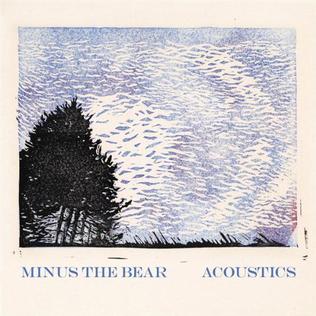
MINUS THE BEAR'S NEW SEVEN SONG EP "ACOUSTICS"


Minus the Bear revisits six songs released on their previous albums with a more organic approach. The one new track, "Guns & Ammo" starts the album off devoid of the keyboards that have become a part of the Seattle band's distinctive sound. Even so, the album still sounds very much like the band we've grown to love and it's awesome to be able to appreciate them in this new light.

Acoustics is definitely good. The difference between these new acoustic tracks and their older counterparts is surprisingly dramatic. When I first caught wind of what Acoustics was about, it smelled a bit like a cheap ploy to make some extra cash with old material (See Metallica, U2). I am very happy to report that that is not the case.

Acoustics is only available online. If you're dying to get your hands on a physical copy then you've got to check them out on tour. Lucky for you, Minus the Bear will be at the Marquee Theatre in Tempe on November 13th.

If you don't live in the Phoenix area check to see when they'll be in your city on their website.